

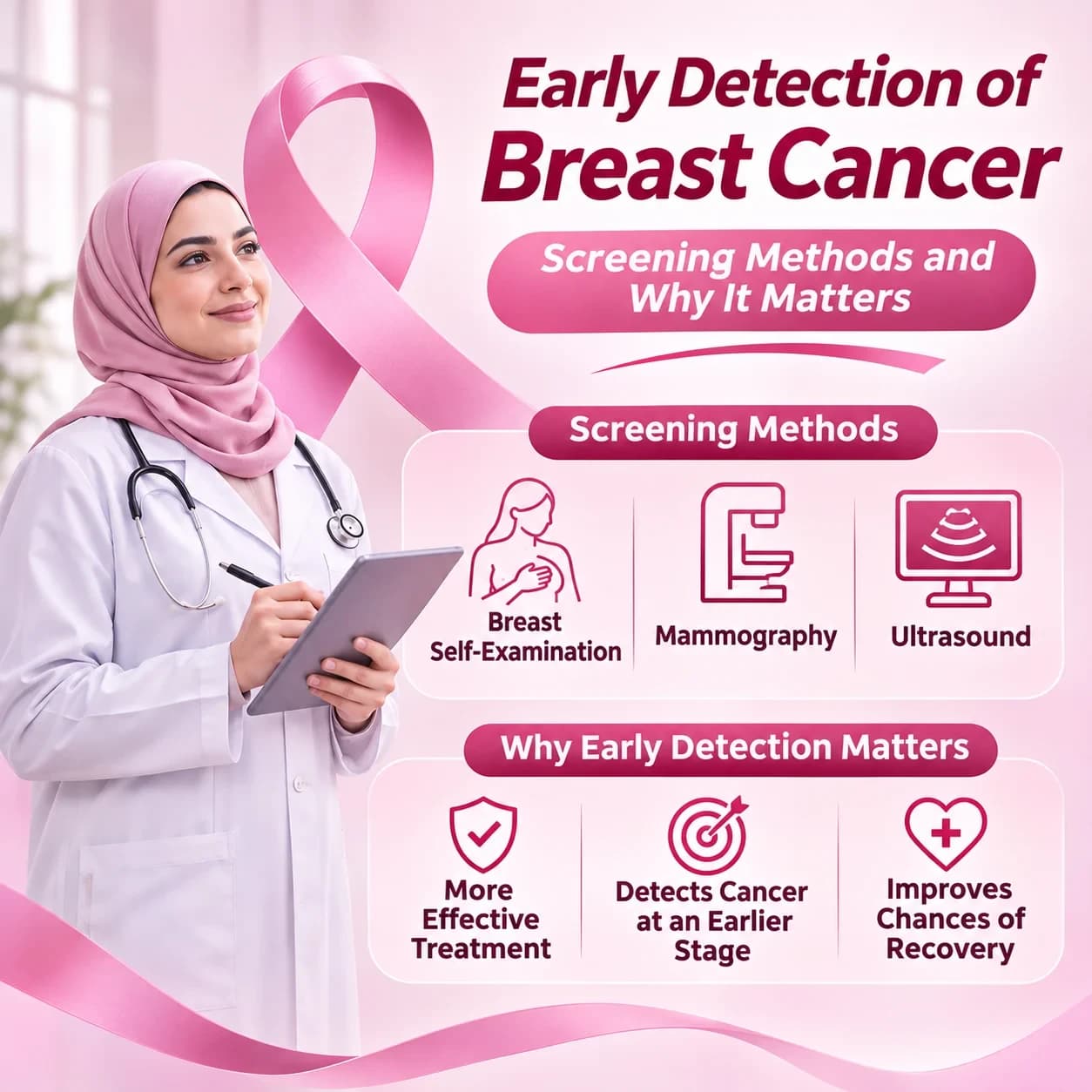
Some changes in the breasts may go unnoticed, and breast cancer in its early stages may not cause pain or noticeable symptoms. That is why women should not wait for symptoms to appear before undergoing the appropriate screening tests, especially as they get older or have risk factors that increase their likelihood of developing the disease.
Early detection helps identify the disease at a stage when treatment is more effective in many cases. In this article, we explore the methods of early breast cancer detection, the recommended age for screening, the differences between mammograms, breast ultrasounds, and self-examinations, as well as how to benefit from the Women's Health Initiative in Egypt.
Medical Disclaimer: This article has been medically reviewed by Dr. Marwa Wanas, Consultant of Obstetrics and Gynecology and ICSI, to ensure the accuracy of the medical information presented.
Why Is Early Detection of Breast Cancer Important?
Breast cancer develops when certain cells grow abnormally within breast tissue. These cells may eventually spread to nearby tissues or other parts of the body. Early detection is important because it can identify cancerous changes before they become noticeable or cause clear symptoms, allowing evaluation and treatment to begin at an appropriate time.
The World Health Organization explains that early detection relies on two main approaches: early diagnosis when unusual symptoms appear, and regular screening for women who have no symptoms to identify the disease before signs develop. It is important to understand that screening does not prevent breast cancer, but it helps detect the disease early and reduces the likelihood of it reaching advanced stages.
What Are the Methods of Early Breast Cancer Detection?
Breast health assessment does not rely on a single method in every case. The doctor selects the appropriate examination based on age, symptoms, family history, and risk level.
1. Mammogram (Breast X-Ray)
A mammogram is a breast imaging test that uses a low dose of X-rays. It is considered the primary screening method for many women in the recommended age groups. It can detect small changes that may not be noticeable during a physical breast examination, so having a lump or pain is not a prerequisite for undergoing the test.
The doctor may request additional imaging if an area requires further evaluation. However, an abnormal result does not necessarily mean breast cancer is present. It may be related to benign changes or require more detailed images or a biopsy to determine its nature.
2. Breast Ultrasound
A breast ultrasound uses sound waves to produce images of breast tissue. It helps distinguish between certain solid lumps and fluid-filled cysts. Doctors may recommend it to evaluate a palpable lump, follow up on mammogram findings, or assess specific cases involving dense breast tissue.
However, ultrasound is not automatically a replacement for mammography in routine screening. Each method has different uses and limitations, and the doctor determines whether one or both are needed based on the individual case.
3. Clinical Breast Examination
A doctor or healthcare provider examines both breasts and the surrounding areas, including the armpits, to look for lumps or unusual changes. This examination helps assess symptoms and determine which tests may be needed next, but it cannot replace appropriate imaging methods for early detection.
4. Breast Awareness and Self-Examination
Being familiar with the normal appearance and feel of your breasts can help you notice any new changes, such as a lump or changes in the skin or nipple. Women can look out for these changes while showering or getting dressed, without needing to follow a complicated technique or consider self-examination a diagnostic method.
It is important to emphasize that self-examination does not replace mammograms or medical examinations. Some tumors cannot be felt, and imaging may detect them before they become noticeable.
What Is the Recommended Age to Start Breast Cancer Screening?
The recommended age for starting mammograms and the frequency of screening vary according to medical guidelines and individual risk factors. For example, the U.S. Preventive Services Task Force recommends mammograms every two years for women aged 40 to 74 who are at average risk. Other medical organizations recommend different schedules, such as annual screening for certain age groups.
Women at higher risk may need to start screening at a younger age or add breast MRI to mammography, based on their doctor's assessment. Important risk factors include having an inherited genetic mutation associated with breast cancer, a first-degree relative with the disease, a personal history of breast cancer, or previous radiation therapy to the chest at a young age.
Therefore, the same screening schedule should not be applied to all women. Nor should the evaluation of any unusual symptom be delayed until a woman reaches the recommended age for routine screening.
What Breast Cancer Symptoms Require Medical Attention?
Symptoms may not appear in the early stages, but certain changes require prompt medical evaluation, including:
A new lump in the breast or under the armpit.
Noticeable changes in breast size or shape.
Skin retraction or dimpling that resembles the texture of an orange peel.
New nipple inversion or an unusual change in its appearance.
Nipple discharge, especially if it is bloody or occurs spontaneously.
Persistent redness, changes in breast skin, or sores around the nipple.
These signs do not necessarily indicate breast cancer, as many benign conditions can cause similar changes. However, the cause cannot be determined through observation alone. Therefore, women should consult a doctor to assess the condition and choose the appropriate tests.
Where Can You Find the Early Breast Cancer Detection Initiative in Egypt?
The Presidential Initiative for Women's Health provides screening and awareness services for women across Egypt's governorates. These services include clinical breast examinations and education on how to recognize changes, with referrals for women who need further assessment.
According to the initiative's official website, its services target women aged 18 and above. Screening and awareness services are provided through primary healthcare units, with access to advanced examinations for cases that require them. The initiative states that its services are free of charge.
To find locations offering breast cancer screening through the initiative, whether in Giza or other governorates, visit the 100 Million Health website or call the hotline at 15335 to find the nearest available unit. It is best to confirm the location and service hours before visiting rather than relying on outdated addresses or lists.
What Should You Do If Your Screening Result Is Abnormal?
An abnormal mammogram result does not confirm breast cancer. Further images or an ultrasound may be needed to examine a specific area more closely. If imaging tests continue to raise concerns, the doctor may recommend a tissue biopsy and laboratory examination to determine the nature of the cells.
The next step depends on the imaging results, clinical examination, and medical history. Therefore, it is important not to miss follow-up appointments or postpone recommended tests, even if there is no pain or other symptoms. Keeping previous reports and images also helps the doctor compare results and determine whether a change is new or has been present before.
Book Your Breast Examination and Take Care of Your Breast Health
Taking care of your breast health is not limited to waiting for symptoms to appear. Understanding risk factors and following the recommended screening schedule can help detect changes at the right time. As part of her examination and early diagnosis services, Dr. Marwa Wanas offers breast cancer screening. You can contact the clinic to ask about the examination and schedule a suitable appointment.
To book an appointment or make an inquiry at Dr. Marwa Wanas Clinic in Alexandria, call 01279272396 or contact the clinic via WhatsApp.
Frequently Asked Questions About Early Breast Cancer Detection
Can Breast Cancer Develop Without Causing Pain?
Yes. Breast cancer may develop without pain or noticeable symptoms. The first sign may be a painless lump or a change that is not easily noticed by the woman. Therefore, the presence or absence of pain should not determine whether screening is necessary.
Can an Ultrasound Replace a Mammogram?
No. Each examination serves a different purpose. Mammography is widely used for routine screening, while ultrasound helps evaluate certain lumps and changes and provides additional imaging when needed. The doctor determines the appropriate method based on age, symptoms, and breast tissue density.
Can Self-Examination Detect Breast Cancer Early?
Self-examination and breast awareness can help women notice unusual changes, but they cannot detect every tumor and are not a substitute for mammograms or recommended routine medical examinations.
Where Are the Early Breast Cancer Screening Initiative Locations in Giza?
The Women's Health Initiative provides services across all Egyptian governorates, including Giza. You can find the nearest unit offering screening through the 100 Million Health website or by calling the hotline at 15335. Make sure to confirm service availability and opening hours before your visit.
Can a Mammogram Show an Abnormal Result Without Cancer Being Present?
Yes. A mammogram may reveal changes or areas that require further examination, which may later turn out to be benign. Therefore, an imaging result alone is not always a final diagnosis. Depending on the findings, the doctor may request an ultrasound, additional imaging, or a biopsy.