

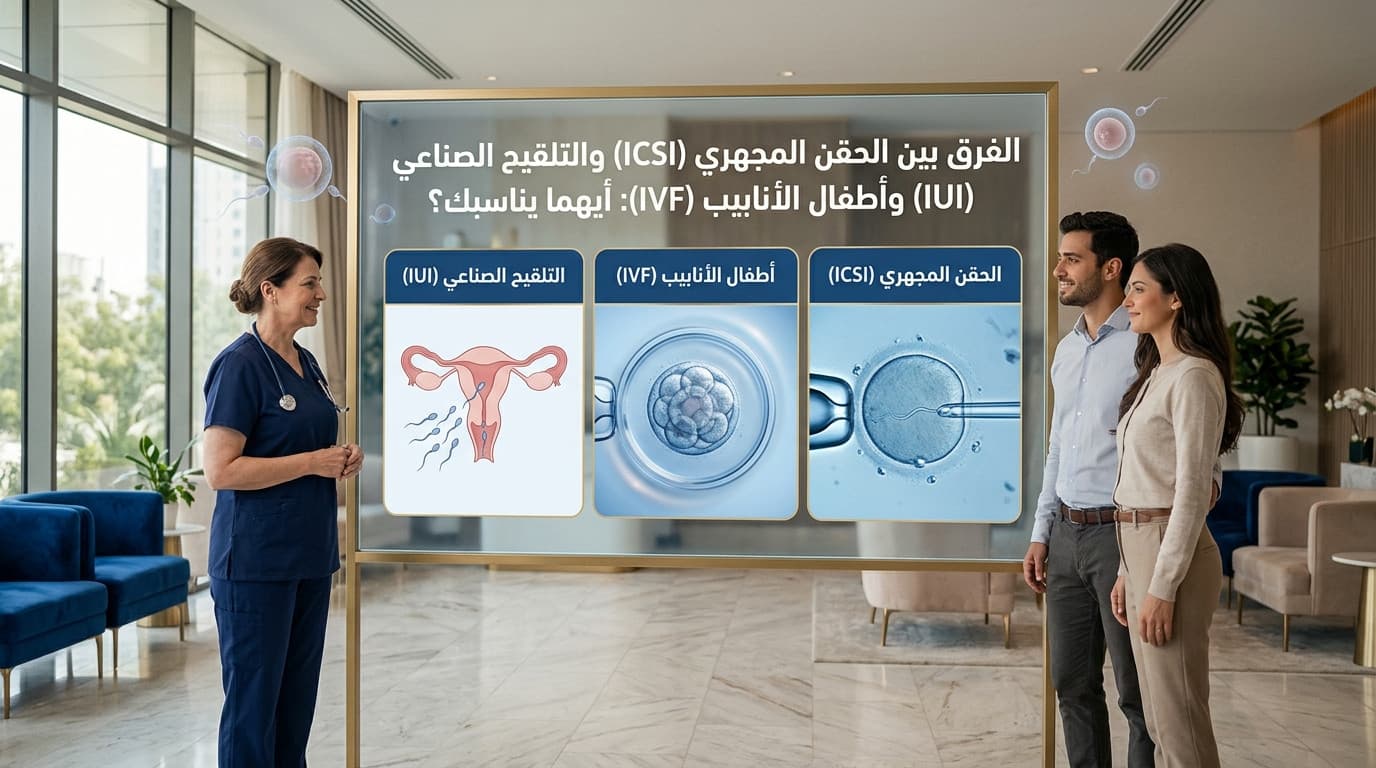
Many couples begin searching for the most effective fertility treatment when they experience difficulty conceiving. Thanks to advances in reproductive medicine, several assisted reproductive techniques are now available, including Intrauterine Insemination (IUI), In Vitro Fertilization (IVF), and Intracytoplasmic Sperm Injection (ICSI).
Although these terms are often used interchangeably, they refer to different fertility treatments. Each procedure has its own technique, recommended indications, and success rates, which vary depending on factors such as the woman's age, overall health, and the underlying cause of infertility.
Choosing the right fertility treatment is not simply a matter of preference. It requires a comprehensive medical evaluation, including diagnostic tests to determine the cause of infertility. In this guide, we explain the differences between IUI, IVF, and ICSI, when each treatment is recommended, and the factors specialists consider when selecting the most appropriate option.
What Is Intrauterine Insemination (IUI)?
Intrauterine Insemination (IUI) is one of the least invasive fertility treatments. During the procedure, a semen sample is processed in the laboratory to separate healthy, motile sperm from weaker or less active sperm.
The prepared sperm are then placed directly inside the uterus around the time of ovulation to increase the likelihood of fertilization.
Unlike IVF and ICSI, IUI does not require egg retrieval, laboratory fertilization, or anesthesia.
IUI is commonly recommended for:
Mild male factor infertility.
Ovulation disorders after medical treatment.
Unexplained infertility.
Cervical conditions that interfere with sperm movement.
Although the procedure is relatively simple, its success depends on several factors, including the woman's age, egg quality, and the condition of the fallopian tubes.
What Is In Vitro Fertilization (IVF)?
In Vitro Fertilization (IVF) is one of the most commonly performed assisted reproductive technologies. The treatment begins with ovarian stimulation to encourage multiple eggs to mature. The eggs are then retrieved through a minor surgical procedure.
The collected eggs are placed together with sperm in a specialized laboratory, where fertilization occurs naturally. The resulting embryos are monitored for several days before the healthiest embryo or embryos are transferred into the uterus.
IVF is commonly recommended for:
Blocked or damaged fallopian tubes.
Endometriosis.
Failed IUI attempts.
Certain cases of male infertility.
Long-standing infertility.
One of the major advantages of IVF is the ability to monitor embryo development and select high-quality embryos before transfer.
What Is Intracytoplasmic Sperm Injection (ICSI)?
Intracytoplasmic Sperm Injection (ICSI) is an advanced form of IVF. While many of the treatment steps are similar, the fertilization process is different.
Instead of allowing sperm to fertilize the egg naturally in the laboratory, an embryologist selects a single healthy sperm and injects it directly into the egg using highly specialized microscopic equipment.
After successful fertilization, the embryos are cultured and later transferred into the uterus in the same way as conventional IVF.
ICSI is commonly recommended for:
Severe male infertility.
Very low sperm count.
Poor sperm motility.
Significant sperm abnormalities.
Surgically retrieved sperm.
Previous IVF cycles with failed fertilization.
Certain genetic conditions requiring embryo testing.
When Is IUI Recommended Instead of IVF or ICSI?
No single fertility treatment is appropriate for every patient. Fertility specialists consider several important factors before recommending a treatment plan, including:
Female age.
Ovarian reserve.
Egg quality.
Semen analysis results.
Uterine and fallopian tube health.
Duration of infertility.
Previous fertility treatments.
Patients with relatively mild fertility issues may begin with IUI. However, IVF or ICSI may be recommended immediately if the chances of success with IUI are considered low.
Difference Between ICSI, IVF, and IUI
Although all three treatments aim to help couples achieve pregnancy, they differ significantly in how fertilization takes place.
Comparison | IUI | IVF | ICSI |
|---|---|---|---|
Fertilization Location | Inside the woman's body | In the laboratory | In the laboratory |
Fertilization Method | Natural fertilization after sperm placement | Eggs and sperm are combined together | A single sperm is injected directly into the egg |
Egg Retrieval | No | Yes | Yes |
Anesthesia | Usually not required | Required during egg retrieval | Required during egg retrieval |
Best For | Mild infertility | Moderate infertility | Severe male infertility and complex cases |
Procedure Complexity | Low | Moderate | Higher than IVF during fertilization |
Although ICSI is considered a more advanced fertilization technique, it is not automatically the best choice for every patient. Successful treatment depends on selecting the procedure that best matches the individual's fertility condition.
Is ICSI Better Than IVF?
Neither treatment is universally better than the other. The primary difference lies in how fertilization occurs.
In conventional IVF, sperm fertilize the egg naturally in the laboratory. In ICSI, a single sperm is directly injected into the egg.
When sperm quality is normal, IVF often produces excellent results. However, for severe male infertility, ICSI generally offers a higher chance of successful fertilization.
For this reason, fertility specialists recommend the most appropriate treatment based on comprehensive medical evaluation rather than choosing the same procedure for every patient.
What Factors Affect Success Rates?
Success rates vary from one patient to another. Important factors include:
Female age, especially after age 35.
Egg quality.
Sperm quality.
The underlying cause of infertility.
Experience of the fertility center.
Quality of the embryology laboratory.
Lifestyle factors such as smoking and obesity.
Medical conditions including polycystic ovary syndrome (PCOS) and endometriosis.
Following the treatment plan carefully and attending regular follow-up appointments can also improve the chances of success.
Can Patients Move from IUI to IVF or ICSI?
Yes. Many couples begin treatment with IUI and later transition to IVF or ICSI if pregnancy does not occur or if further evaluation indicates that advanced treatment offers a higher chance of success.
The decision depends on the number of unsuccessful treatment attempts, the woman's age, and the overall fertility assessment.
How Does Your Fertility Specialist Choose the Right Treatment?
Choosing the most appropriate fertility treatment depends on a complete medical evaluation rather than cost or popularity.
The fertility specialist considers factors such as:
The cause of infertility.
Ultrasound and laboratory findings.
Semen analysis.
Ovarian reserve.
Female age.
Expected success rates for each treatment option.
As a result, two patients with similar symptoms may receive different treatment recommendations based on their individual medical conditions.
in the end Intrauterine Insemination (IUI), In Vitro Fertilization (IVF), and Intracytoplasmic Sperm Injection (ICSI) are all effective assisted reproductive technologies used to treat infertility. However, each procedure serves a different purpose and is recommended for specific fertility conditions.
IUI is generally suitable for mild infertility, while IVF and ICSI are more advanced procedures designed for moderate to complex fertility challenges. The most appropriate treatment is determined through a thorough medical evaluation rather than choosing the most advanced technique.
Consulting an experienced fertility specialist is the first step toward selecting the right treatment plan and maximizing the chances of achieving a healthy pregnancy.
Frequently Asked Questions
Is ICSI the same as IVF?
No. ICSI is a specialized form of IVF. While both procedures involve egg retrieval and embryo transfer, ICSI differs because a single sperm is injected directly into the egg.
Which treatment is less expensive: IUI or ICSI?
IUI is generally less expensive because it is a simpler procedure that does not require egg retrieval or laboratory fertilization.
Can pregnancy occur after the first treatment cycle?
Yes. Pregnancy can occur after the first cycle, but success depends on factors such as age, fertility diagnosis, egg quality, sperm quality, and overall reproductive health.
Does age affect the success of all fertility treatments?
Yes. Female age is one of the most important factors influencing the success rates of IUI, IVF, and ICSI because egg quality naturally declines over time.
Does everyone need ICSI?
No. ICSI is recommended only when medical evaluation indicates that it provides a better chance of fertilization than other assisted reproductive techniques.